HOW-TO
How to Use a Kamado Grill: The Complete Guide
How to use a kamado grill, start to finish: charcoal, lighting, vents, direct and indirect heat, burping, shutting down and cleaning, UAE edition.
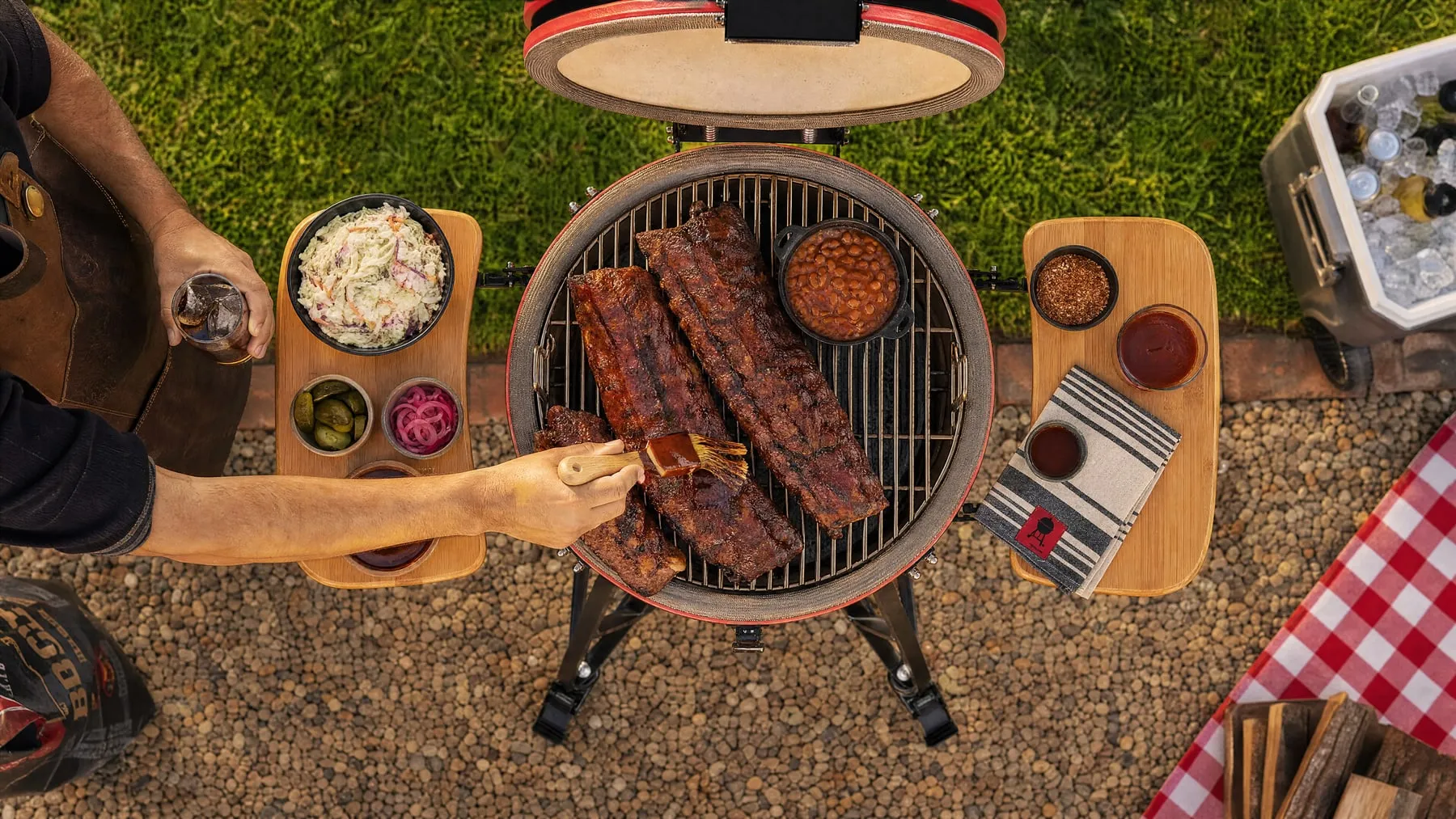
A kamado is two vents and a lid. Learn what air does to fire and you can cook anything on it, from an 18-hour brisket to a 90-second pizza.
So, how do you use a kamado grill? Fill it with lump charcoal, light it without chemicals, then set the temperature with the vents: wide open for searing heat, barely open for low and slow. Add a heat deflector when you want indirect heat, and keep the lid closed. That’s the whole method. The rest of this guide shows you each step, with the exact coal loads, vent settings and dome temperatures from our own recipes.
Kamado school. Start here, then go deeper:
- New grill? First Fire: unboxing, curing and your first cook
- Still choosing? What size kamado do you need?
- Ready to cook? All our recipes, each with its own fire settings
- Kit: kamado accessories, from the chimney starter to the pizza stone
- Quick answers: the kamado FAQ
How a kamado grill works
A kamado is a ceramic oven with a fire at the bottom. Three ideas explain everything it does.
The ceramic: why thick walls hold heat
Our kamados are made from ceramic fired three times. Thick ceramic soaks up heat and gives it back slowly, so once the dome reaches temperature it stays there with very little help from you. That’s why a kamado runs all night on one load of coal, and why it uses so little fuel. The sealed chamber also holds moisture in, so meat dries out far less than on an open grill.
Air in, heat out: the two vents
Every kamado has a vent at the bottom and one at the top. On ours, that’s the bottom door and a cast-iron top vent.
- The bottom door feeds the fire. It’s your coarse control: more air in, more fire.
- The top vent fine-tunes it. It lets the heat and smoke out, which pulls fresh air through the coal.
Open both wide and the fire roars past 350°C. Close them to a crack and it settles at 120°C and stays there. That’s all temperature control is.
What’s inside
From the bottom up: the ceramic base, the fire box that holds the coal, the stainless charcoal grate in the bottom of the fire box, the fire ring that sits on top of it, and the stainless cooking grate on the ring. The domed lid carries the thermometer and the top vent. On the 23″, 25″ and 27″ you also get a smoker chute.
Before you light it
Where to put it
Outdoors, on a stable, level surface, away from anything that can catch fire. The 15″ sits happily on a sturdy table, a boat deck or the sand; the 18″ and up roll on their own wheeled stand. Never use a kamado indoors or in a closed space: burning charcoal gives off carbon monoxide, which you can’t see or smell (see the US Consumer Product Safety Commission’s charcoal safety tips and the CDC’s carbon monoxide advice). If you live in an apartment, check your building’s rules before you cook on a balcony.
New kamado? Break it in first
A brand-new kamado wants a gentle first fire or two before you push it hard. We cover unboxing, assembly and that first, low fire step by step in First Fire.
The kit you need
- Hardwood lump charcoal. Ours is Burnt-Carbon Coal.
- A way to light it: a chimney starter, paper or kindling.
- Heat-resistant gloves, for moving grates and deflectors.
- A probe thermometer, for the food itself.
- A heat deflector for indirect cooking. It isn’t in the box: the heat deflectors come with our Divide & Conquer system, which fits every size.
Charcoal: what to use and how much
Use hardwood lump charcoal, nothing else. Lump burns clean and hot and leaves little ash. Whatever you burn ends up in your food, which is why we never use lighter fluid or chemical-soaked coal. On the 15″, break large pieces into smaller fragments so they fit the fire box.
How much charcoal in a kamado
Match the load to the cook. These are the loads from our own recipes:
| Cook | Coal load | Our recipe |
|---|---|---|
| Long low and slow (8–18 hours) | 3–4 kg lump + 2–3 oak chunks | Beef ribs 3 kg · lamb shoulder matfoon 3.5 kg · brisket 4 kg |
| Roasting and baking | Half the fire box | Roast chicken, salt-crust sea bream |
| Direct grilling and quick searing | Half the fire box, fully lit | Shish tawook, charred prawns |
| Reverse sear and pizza | Fill to the fire ring | Reverse-seared tomahawk, stone-baked pizza |
Don’t worry about waste. When you shut the kamado down properly, the coal that’s left stays in the fire box and lights again next time.
Smoking wood
For smoke flavour, bury a few wood chunks through the coal before you light it. Our brisket, beef ribs and lamb all use oak. For an extra layer of smoke on a shorter cook, wood chips in a hot smoker box set in the coals do the same job.
How to light a kamado grill
- Clear the old ash. Ash blocks the air, and a fire with no air won’t get hot.
- Open both vents fully while you light.
- Fill the fire box with lump charcoal, to the level your cook needs.
- Light it with one of the methods below.
- Let it catch, then close the lid and start setting the vents.
Chimney starter (for hot, direct cooks)
Fill the chimney starter with coal, put kindling or paper under it and light it. In minutes you have a fully lit bed of coal. Tip it into the fire box and top up with unlit coal. It’s the quickest way to grilling and searing heat.
One spot in the centre (for low and slow)
For a long cook, you want a small fire that grows slowly. Fill the fire box, bury your smoking wood through it and light one spot in the centre with a little kindling. That’s exactly how our 18-hour brisket starts.
Paper and kindling
Both work well. Push them into the coal and light them; once the coal around them glows, you’re away.
Never use lighter fluid
Lighter fluid and chemical firelighters don’t belong in a kamado. Ceramic is porous: it soaks up the chemicals, and you’ll taste them in your food for days.
Controlling temperature with the vents
Bottom door for the fire, top vent for the fine-tuning. That’s the rule. A few habits make it work:
- Come up to temperature from below. Close both vents halfway before you reach your target. A kamado holds heat so well that it’s easy to overshoot, and slow to come back down.
- Make small moves. Adjust a vent by about a finger’s width, then wait ten minutes before you judge the result.
- Set it, then leave it. Once the dome is steady, stop touching the vents.
Three settings from our recipes show the range:
| Dome temperature | Top vent | Bottom door | Recipe |
|---|---|---|---|
| 125°C, low and slow | A 2 mm crack | One finger’s width | The 18-hour brisket |
| 180°C, roasting | Half open | Two fingers | Whole roast chicken |
| 350°C+, pizza | Fully open | Fully open | Stone-baked pizza |
Kamados vary, and so does the weather, so treat these as starting points and adjust in small steps.
Reading the dome thermometer
The dome thermometer tells you the temperature of the air in the dome, which is the number every recipe uses. It doesn’t tell you what’s happening inside the food. For that, use a probe thermometer.
How to cook on a kamado: the five setups
Everything you cook on a kamado uses one of five setups. The difference is whether the heat deflector is in, how much coal you light and how far the vents are open.
| Setup | Deflector | Coal | Top vent / bottom door | Dome | Try this recipe |
|---|---|---|---|---|---|
| Smoke, low and slow | In | 3–4 kg lump + oak chunks | 2–3 mm crack / one to one and a half fingers | 120–130°C | Brisket, beef ribs, lamb shoulder matfoon |
| Roast and bake | In, with a drip pan | Half the fire box | Half open / two fingers | 180–200°C | Roast chicken, salt-crust sea bream |
| Grill, direct | Out | Half the fire box, fully lit | Half open / half open | About 250°C | Shish tawook |
| Sear | Out | Half the fire box to full | Three-quarters to fully open / fully open | 280–300°C+ | Charred prawns, tomahawk |
| Pizza and flatbread | In, stone on the grate | Fill to the fire ring | Fully open / fully open | 350°C+ | Stone-baked pizza |
Smoking low and slow
Deflector in, a full load of coal with oak buried through it, and both vents barely open. Let the dome settle at temperature for 20 to 30 minutes, until the smoke runs thin and blue, before the meat goes on. Then close the lid and leave it. A brisket’s internal temperature will stall around 65–70°C for hours; that’s normal, so don’t open the lid and don’t touch the vents.
Roasting and baking
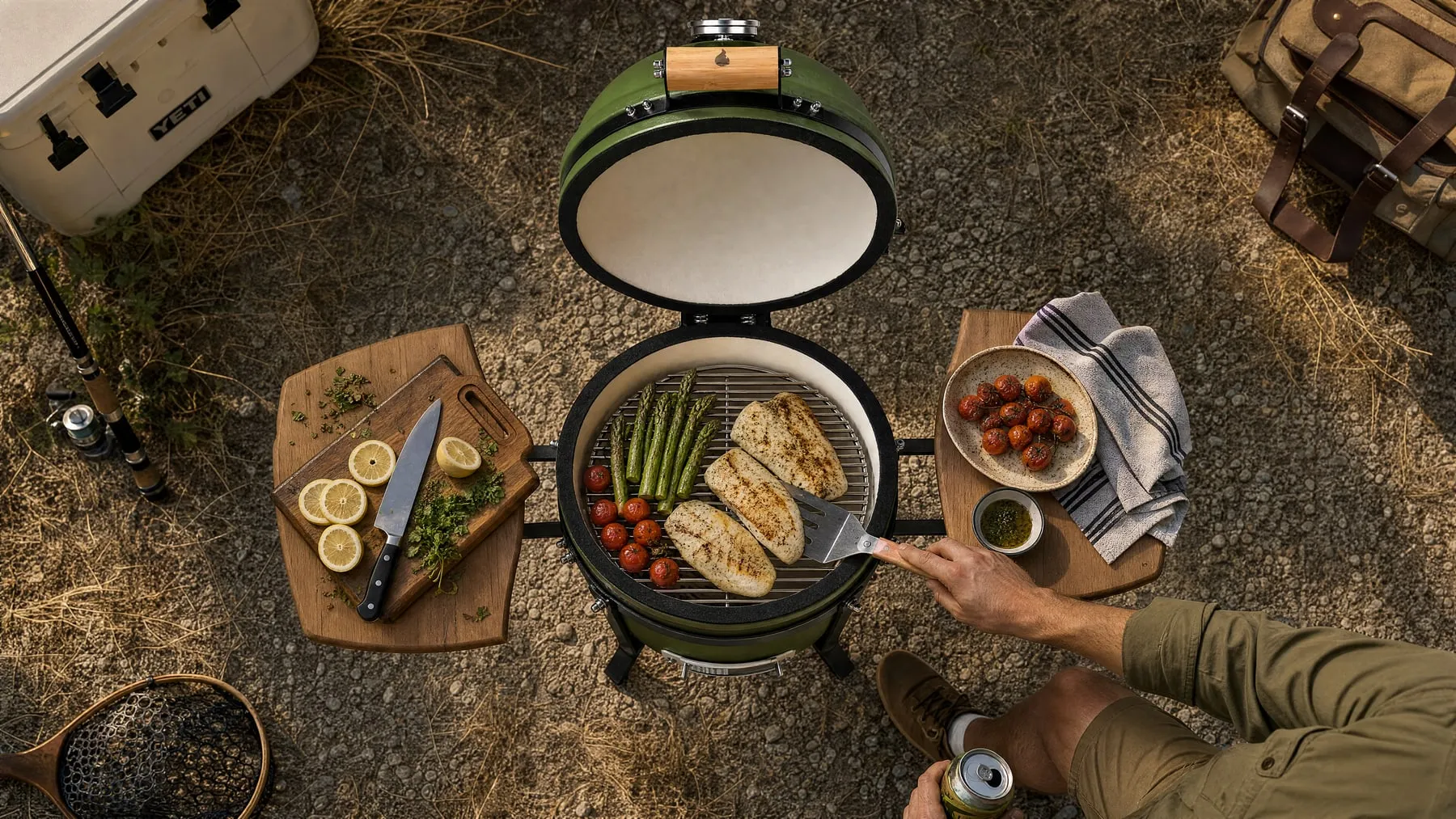
This is the kamado as an oven. Deflector in, a drip pan with a splash of water on it, grate on, and settle the dome at 180–200°C. Whole birds and whole fish roast evenly here because no flame touches them. Our roast chicken is the best first cook there is: forgiving, fast, and very hard to get wrong.
Direct grilling
Deflector out, grate straight over a fully lit bed of coal, dome around 250°C. This is where kebabs, burgers and shish tawook belong. Turn every few minutes and close the lid between turns, which keeps flare-ups down.
Searing and the reverse sear
For a real crust, open both vents and let the dome climb past 280°C. Thick steaks do best with a reverse sear. Cook the tomahawk low at 120°C with the deflector in until it reaches 48°C inside. Then pull it, lift out the deflector with gloves on, open both vents fully until the dome passes 300°C, and sear for 60–90 seconds a side. For a ripping-hot surface on seafood, heat a cast-iron pan on the grate for ten minutes first, as in our charred prawns.
Pizza and flatbread on a stone
Deflector in, grate on, pizza stone on the grate, coal filled to the fire ring and both vents fully open. Once the dome passes 350°C, let the stone heat through for a full 30 minutes. Each pie takes about 90 seconds, and the stone needs two minutes with the lid closed to recover between pies. The pizza stone fits the 21″ and up.
Two zones at once
With the Divide & Conquer system, a three-tier platform with two half-moon grates and two ceramic heat deflectors, you can run a hot zone and a cool zone under one dome. Sear on one side while ribs sit low and slow on the other.
Opening the lid safely: burping
On a hot fire, never fling the lid open. When a kamado is running hot with the vents nearly closed, the fire is short of air. Open the lid all at once and the rush of oxygen can make the fire flare up at you.
So burp it. Lift the dome a few centimetres and hold it there for a few seconds, then open it all the way. Fresh air arrives gently, not all at once. Make it a habit every time you open the lid on a hot cook.
Cooking to temperature, not time
Recipe times are a guide; the probe thermometer has the final say. These are the internal temperatures from our recipes:
- Chicken: 80°C in the thickest part of the thigh, and at least 74°C in the breast.
- Shish tawook: 74°C inside, with charred edges.
- Brisket: about 95°C, when the probe slides in like butter.
- Beef ribs: 96–98°C, when the rack wobbles.
- Tomahawk: pull at 48°C, sear, and aim for 54°C for medium-rare.
Large cuts keep cooking for a while after they come off the heat, which is why the tomahawk is pulled before it reaches its final temperature. For food-safety minimums, see the USDA’s safe temperature chart.
How to shut down a kamado
When you’ve finished cooking:
- Close the bottom door fully.
- Close the top vent fully.
- Keep the lid down.
With no air, there’s no fire. The coal goes out and whatever’s left stays in the fire box, ready for your next cook. You don’t need water to put it out.
The dome stays hot for hours, so leave it alone and keep children and pets clear. Empty the ash only when everything is completely cold: hot coals keep giving off carbon monoxide even after the flames are gone.
Looking after your kamado
Cleaning
Clean the inside with fire. Run the kamado hot for a while with the dome closed and the residue burns off; brush the cooking grate while it’s still warm. Clear the old ash before every cook. Never use soap or chemicals inside, because ceramic soaks them up and whatever goes in comes out in your food. The outside can simply be hosed down.
Living outdoors in the UAE
Every dome is fired three times so it can stand up to a Dubai summer, and the glaze is fused into the ceramic. A few habits keep everything else in good shape:
- Close both vents whenever the grill is cold so sand stays out of the fire box.
- After a shamal, brush off the grates and check that both vents still move freely before you light.
- Shade is kinder to the wooden side tables and the metalwork.
- Every few months, check that the bolts on the metal bands and the hinge are snug, because metal moves with heat.
Moving and lifting
Ceramic is heavy. Lift with two people, from underneath the base, and never by the handle, the hinge or the side tables. Every Burnt Carbon kamado’s ceramic body carries a 25-year warranty against material defects.
Troubleshooting
| Problem | Likely cause | Fix |
|---|---|---|
| It won’t get hot | Ash blocking the air, too little coal, or vents closed | Clear the ash, add coal and open both vents |
| It overshoots the target | Vents closed too late | Close down and wait. Come up from below next time |
| Bitter, white smoke | The fire hasn’t settled | Wait until the smoke runs thin and blue before the food goes on |
| The fire keeps going out | Not enough air getting through | Clear the ash and open the top vent a little more |
| Flames flare up when you open the lid | The lid was opened all at once on a hot fire | Burp the lid every time |
| Sand in the fire box | Vents left open while the grill was cold | Close both vents after every cook |
What to cook first
Learn the setups in this order and each cook teaches you something new:
- Whole roast chicken at 180°C: indirect heat, and the best first cook there is. First Fire walks you through it.
- Shish tawook at 250°C: direct grilling.
- Reverse-seared tomahawk: low to high in one cook.
- Stone-baked pizza at 350°C+: everything wide open.
- The 18-hour brisket: the graduation cook.
That’s how to use a kamado grill
Fuel, fire, air, lid. That’s how to use a kamado grill, and the rest is practice. Practice tastes good.
Pick a recipe, follow its coal load and vent settings exactly the first time, and adjust from there. Every recipe on our site gives you all four numbers.
Haven’t got a kamado yet? Find your size →
Questions people ask
How does a kamado grill work?
A kamado is a thick ceramic oven heated by charcoal. Air comes in through the bottom door, feeds the fire and leaves through the top vent. More air makes a hotter fire, less air a cooler one. The ceramic stores the heat, so the temperature stays steady for hours on one load of coal.
How long does it take a kamado to heat up?
It depends on the cook. For low and slow, our recipes let the dome settle for 20 to 30 minutes at temperature, until the smoke runs thin and blue. For pizza, the stone needs a 30-minute heat-soak once the dome passes 350°C. Hot, direct cooks come up faster on a fully lit bed of coal.
How much charcoal should I put in a kamado?
For pizza and searing, fill to the fire ring. For roasting and grilling, about half the fire box. For a long smoke, a full load. Our 18-hour brisket runs on 4 kg of lump. Shut both vents when you finish and the unburnt coal lights again next time.
How do you shut down a kamado?
Close the top vent and the bottom door fully and keep the lid down. With no air, the fire goes out and the leftover charcoal is saved for your next cook. The dome stays hot for hours, so leave it alone, keep children and pets clear, and only empty ash once everything is completely cold.
Should I cook burgers direct or indirect on a kamado?
Direct. Leave the deflector out, put the grate straight over a fully lit bed of coal and settle the dome around 250°C. Close the lid between turns to keep flare-ups down. Use indirect heat for thick cuts, whole birds and anything that needs time rather than char.
Can you use a kamado in the rain?
Yes. The ceramic doesn't mind water, and the lid keeps the cooking chamber covered. Keep the bottom door clear so water doesn't collect in the fire box. In the UAE you will fight sand far more often than rain, so close both vents when the grill is cold.
Can you use a kamado indoors?
No. Burning charcoal gives off carbon monoxide, which can kill in an enclosed space, even with a window open. Use a kamado outdoors only, away from doors, windows and anything that can catch fire. If you live in an apartment, check your building's rules before using one on a balcony.
Can you use a kamado as a tandoor?
Not quite, but it gets close. With both vents fully open a kamado runs past 350°C, hot enough for flatbreads on a pizza stone and charred kebabs over direct coal. It isn't built for slapping dough onto the walls the way a tandoor is, so don't stick anything to the ceramic.
FROM THE KILN
COOK YOUR FIRST RECIPE.
Every recipe on the site gives you the coal load, both vent settings and the dome temperature. Start with the roast chicken and work up to the 18-hour brisket.