HOW-TO
The Best Charcoal for a Kamado: Lump Charcoal vs Briquettes
Which charcoal belongs in a kamado? Lump vs briquettes, coconut and binchotan, how much each cook uses, and what charcoal really costs in the UAE.
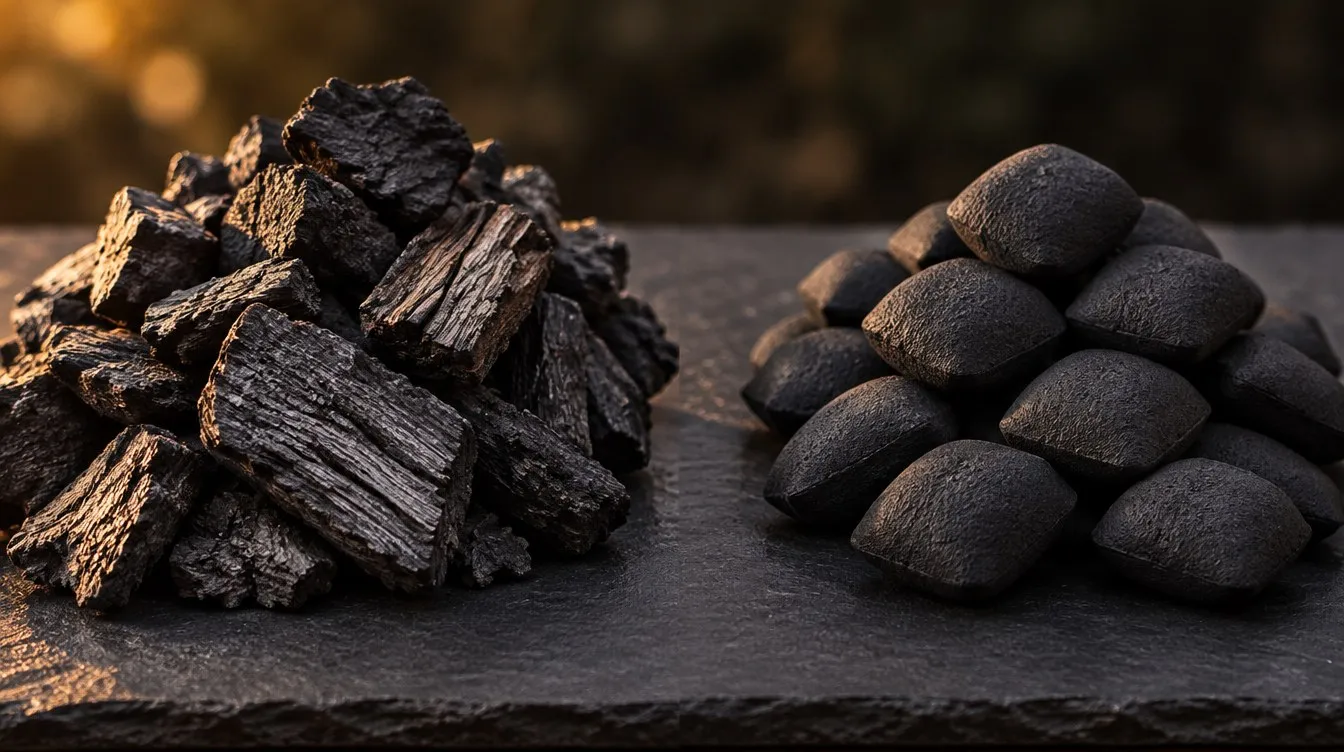
Above: hardwood lump on the left, briquettes on the right (illustrative image).
Whatever you burn ends up in your food. So what should go in the fire box?
The best charcoal for a kamado is large-piece hardwood lump. In the lump charcoal vs briquettes debate, lump wins here for one reason above the others: it leaves little ash, so air keeps flowing through a long cook. It also burns hot and responds quickly to the vents. Plain briquettes will burn, but they leave more ash. Instant-light charcoal never belongs in a kamado.
We sell our own coal, so read this knowing that. The checklist below works for any brand, and we show you the prices of the others too. New to kamados? Start with how to use a kamado grill.
Lump charcoal vs briquettes at a glance
| Hardwood lump | Briquettes | |
|---|---|---|
| Made from | Pieces of real hardwood, carbonised | Sawdust and char pressed with binders |
| Shape | Irregular, mixed sizes | Uniform |
| Heat | Burns hotter | Moderate and even |
| Response to vents | Quick | Slower |
| Ash | Little | More |
| Burn | Less predictable in an open grill | Steady and predictable |
| Reuse in a kamado | Yes | Possible, but more ash to clear |
| Best suited to | Kamados | Kettles and other open grills |
Neither is bad charcoal. They suit different grills, and a kamado’s design decides this one.
How each one is made
Lump charcoal
Hardwood is heated in a kiln with very little oxygen until only carbon-rich charcoal is left. That’s why lump still looks like wood, in irregular chunks. Nothing has to hold it together.
Briquettes
Briquettes start with sawdust and char fines, pressed into shape with a binder, often starch. Some contain fillers too. The binders and fillers are where much of the extra ash comes from. Instant-light versions also contain an accelerant, and that’s the type to avoid completely.
Why kamados run best on lump
A kamado has one control system: air. The bottom door lets it in and the top vent lets it out, through openings that are often very small. Our brisket runs on a 2 mm crack at the top and one finger at the bottom.
At openings that small, ash matters. It collects on the charcoal grate underneath the fire and restricts the air. On a 20-minute cook you’d never notice. On a long, low cook, a fire short of air can sag or go out while you sleep.
Lump’s usual weakness barely applies either. In an open grill it can burn out faster than briquettes, but a sealed ceramic dome starves the fire of air. Our 18-hour brisket runs on one 4 kg load.
Can you use briquettes in a kamado?
Yes, you can burn plain briquettes, and they won’t harm the food. Expect more ash to clear, and less headroom on long cooks.
Two cautions:
- Never use instant-light briquettes. Ceramic is porous. It soaks up the chemicals, and you’ll taste them for days.
- Check your warranty. Some kamado makers set rules on fuel, and burning the wrong one can void the warranty. Whichever kamado you own, read its terms.
What to look for in a bag of lump
This checklist works for any brand:
- Big pieces, few fines. Dust and chips sink into the charcoal grate and block the air.
- Dense hardwood. Heavier pieces generally burn longer. Good bags name the wood.
- No chemicals or accelerants. It should say so.
- Dry coal. It shouldn’t feel damp or smell musty.
- A stated origin. Charcoal production has a real environmental footprint, so look for a named source or FSC certification.
What about coconut shell charcoal?
It’s usually sold as pressed briquettes, so check the bag for binders and treat it the same way. Judge it on ash and piece size, not on the word “coconut”.
What about binchotan?
Binchotan is a Japanese white charcoal known for clean, intense heat. It’s slow to light and expensive. It suits a short direct grill, but it’s hard to justify for a long smoke.
What charcoal really costs per cook
A price per bag tells you little. Here’s what our recipes actually load, and what that costs with our own coal at AED 18.75 per kilo:
| Cook | Dome | Time | Coal load | Coal cost |
|---|---|---|---|---|
| 18-hour brisket | 125°C | 16–18 h | 4 kg lump + 3 oak chunks | AED 75 |
| Lamb shoulder matfoon | 120°C | 10 h | 3.5 kg lump + 2 oak chunks | About AED 66 |
| Beef ribs | 130°C | 8 h | 3 kg lump + 2 oak chunks | About AED 56 |
| Roast chicken | 180°C | 1.5 h | Half the fire box | Varies by size |
| Shish tawook | 250°C | 20 min | Half the fire box, fully lit | Varies by size |
| Stone-baked pizza | 350°C+ | 1 h | Fill to the fire ring | Varies by size |
These are the most you’d spend. Oak chunks are extra, and the coal left at the end of a cook isn’t wasted, because it lights again next time.
Loading tip: put the big pieces at the bottom and the smaller ones on top, so air can move through. Bury wood chunks through the coal rather than on top. On the 15″, break large pieces into smaller fragments so they fit the fire box.
Can you reuse charcoal in a kamado?
Yes, and it’s one of the quiet savings of owning one. Close both vents fully when you finish, and with no air the fire goes out. Next time:
- Stir the old coal so the ash drops through.
- Clear the ash out.
- Top up with fresh lump.
- Light it with a chimney starter, paper or kindling. Never lighter fluid.
Smoking wood: the seasoning on top
Charcoal is the base flavour, and wood is the seasoning. Add hickory, oak or cherry the way you’d season a dish. Our brisket, beef ribs and lamb all use oak chunks buried through the coal. For a shorter cook, chips in a hot smoker box set in the coals add an extra layer.
Flavour differences between good charcoals are small next to this. Clean, thin blue smoke matters most, so wait for it before the food goes on. Our low and slow smoking guide shows how.
Buying charcoal in the UAE
Here’s how two options sold in the UAE compare per kilo:
| Charcoal | Type | Bag | Price | Per kg |
|---|---|---|---|---|
| Burnt-Carbon Coal | Hardwood lump | 8 kg | AED 150 | AED 18.75 |
| Kingsford briquettes (ACE) | Briquettes | 7.2 kg | AED 99 | AED 13.75 |
Prices as listed by each seller, checked 31 October 2026. Check before you buy, as they can change.
Ours costs more per kilo than these briquettes, and other sellers offer cheaper lump, so compare before you buy. Whichever you choose, read the bag against the checklist above, because “BBQ charcoal” on the front tells you very little.
Store it well. Keep bags sealed, dry and out of the sun. Coastal humidity makes coal damp and slow to light, and sand finds its way into any open bag.
What we use, and why
Burnt-Carbon Coal is restaurant-quality hardwood lump: large pieces, no chemicals, 8 kg. We searched Ghana, Vietnam, Indonesia, Thailand and Sri Lanka for coal clean enough to sit under food, and it’s the same grade used in Dubai restaurant kitchens. It gives a base flavour subtle enough to build on, which is the point.
The short version
Big lumps, no chemicals, kept dry. That’s the best charcoal for a kamado, whoever makes it.
Questions people ask
What is the best charcoal for a kamado?
Large-piece hardwood lump with no added chemicals. It burns hot and clean, reacts quickly when you move the vents and leaves little ash, so air keeps flowing through a long cook. Avoid bags full of dust and small chips, and never use instant-light charcoal.
Can you use briquettes in a kamado?
You can burn plain briquettes, but they leave more ash, which can block the charcoal grate and starve a long cook of air. Never use instant-light briquettes, because ceramic soaks up the chemicals and you'll taste them. Some kamado makers also void their warranty if you burn briquettes, so check yours first.
Why can't you use briquettes in a kamado grill?
It comes down to airflow. A kamado controls temperature through small vent openings, and briquettes leave a lot of ash from their binders. On a long, low cook that ash builds up under the fire and restricts the air. Lump leaves far less, so the vents keep doing their job.
Does lump charcoal burn hotter than briquettes?
Generally, yes. Lump lights faster, burns hotter and responds more quickly to the vents, which suits a kamado well. Briquettes burn more evenly and predictably, which is why many kettle owners like them. In a sealed ceramic kamado, a long burn comes from controlling the air.
Can you reuse charcoal in a kamado?
Yes. Close both vents when you finish cooking and the fire goes out, leaving unburnt charcoal behind. Next time, stir it so the ash drops through, clear out the old ash, top up with fresh lump and light it.
Does lump charcoal go bad?
Not if it stays dry. Charcoal doesn't spoil, but it absorbs moisture, and damp coal is slow to light and smokes more. Keep it sealed and off the ground, somewhere dry and out of the sand. On the UAE coast, humidity makes a sealed bag worth the trouble.
How long should lump charcoal burn before cooking?
Until the smoke runs thin and blue and the dome is steady at your temperature. Our low-and-slow recipes settle for 20 to 30 minutes at temperature before the meat goes on. For direct grilling, wait until the coal is fully lit.
Which is better for smoking, lump or briquettes?
In a kamado, lump. Briquettes give a steady heat in kettles and other smokers, but in a kamado their ash can build up over a long smoke. Lump keeps the air moving. Most of the smoke flavour comes from the wood chunks you add, not the charcoal.
FROM THE KILN
BIG LUMPS. NO CHEMICALS.
Burnt-Carbon Coal is restaurant-quality hardwood in large pieces, in an 8 kg bag. Delivered with your grill, or on its own.
KEEP
READING.
ALL GUIDES → HOW-TO
Kamado Vent Settings and Temperature Guide: 120°C to 350°C+
Kamado vent settings from 120°C to 350°C+, taken from our recipes: smoking, roasting, searing and pizza. Plus how to fix overshoot and hold all night.
 HOW-TO
How to Use a Kamado Grill: The Complete Guide
How to use a kamado grill, start to finish: charcoal, lighting, vents, direct and indirect heat, burping, shutting down and cleaning, UAE edition.
 CARE
Can a Kamado Live Outdoors in the UAE? Heat, Sand, Humidity, Rain and Covers
Can a kamado live outdoors in the UAE? Yes. How to handle summer sun, shamal sand, humid nights, rare heavy rain and a kamado cover, from a Dubai maker.